
I. Four Methods of Energy Storage Temperature Control Technology
Energy storage temperature control technology mainly includes four methods: air cooling, liquid cooling, heat pipe cooling, and phase change cooling.
- Air Cooling
Air cooling technology is an extension of air conditioning that uses forced convection for heat dissipation, utilizing air as the medium for heat exchange. In situations requiring specific wind speeds, airflow can be achieved through dedicated or system-level fans to create convection. Equipping with fan radiators, high-density fin components, and heat exchangers can produce impinging or crossflow environments, accelerating heat removal and improving cooling efficiency.
Air-cooled temperature control has a simple structure, is easy to install, and has relatively low costs. However, they cannot meet the heat dissipation needs of energy storage systems with larger electrical capacities and may lead to larger internal temperature differences within the battery pack, that is, uneven battery cooling.
- Liquid Cooling
Liquid cooling technology uses liquid as the medium for heat exchange, employing liquid cooling plates (also known as water cooling plates) installed at the heat source, in conjunction with heat exchangers and heat pumps, to dissipate through fluid circulation. Liquid cooling dissipation manages precise temperature control for each battery cell through convective heat exchange.
Liquid cooling systems can be highly integrated with battery packs, are convenient for on-site installation, take up little space, and do not have to worry about dust, condensation, etc. In the event of thermal runaway precursors, liquid cooling solutions can rely on large volumes of heat-carrying medium to force heat dissipation from the battery pack and achieve heat redistribution between battery modules, quickly suppressing the continuous deterioration of thermal runaway and reducing the risk of thermal runaway.
Additionally, liquid cooling technology needs to consider the risk of coolant leakage.
- Heat Pipe Cooling
Heat pipe cooling technology relies on phase change of the cooling medium inside the pipe for heat exchange. The main characteristic of heat pipe cooling is that its heat dissipation speed and efficiency are higher than liquid cooling technology, while the risk of cooling medium leakage is lower. However, the cost of heat pipe cooling technology is relatively high.
- Phase Change Cooling
Phase change cooling technology uses phase change materials to absorb heat and combines with air cooling or liquid cooling systems to expel heat. The main features of phase change cooling are compact structure, low contact thermal resistance, and good cooling effect. However, the absorbed heat needs to be expelled through liquid cooling systems or air-cooling systems, and phase change materials occupy space and increase costs.
II. Comparison of Air Cooling and Liquid Cooling
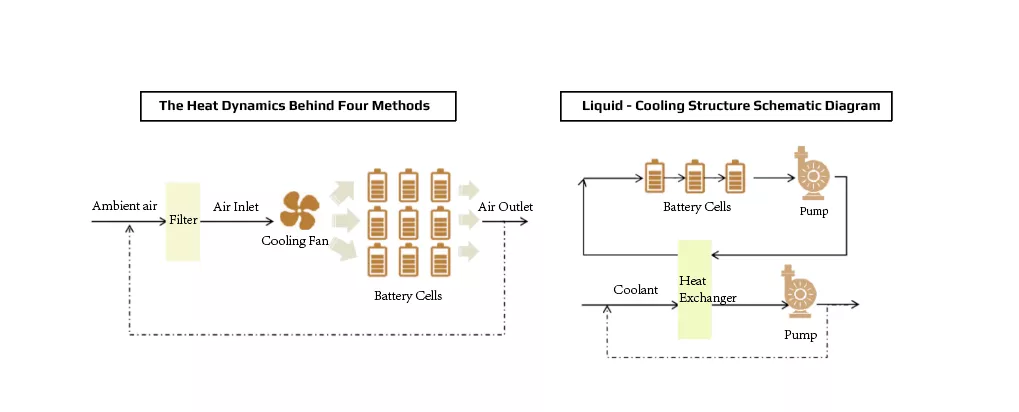
Air cooling and liquid cooling each have their characteristics. The density of antifreeze liquid is 1000 times that of air, and its specific heat capacity is 4 times that of air. Therefore, as a heat carrier, liquid cooling naturally has a larger heat-carrying capacity, lower flow resistance, and higher heat exchange efficiency compared to air cooling. Liquid cooling systems can be highly integrated with battery packs, are convenient for on-site installation, take up little space, and do not have to worry about dust, condensation, etc.
In the event of thermal runaway precursors, liquid cooling solutions can rely on large volumes of heat-carrying medium to force heat dissipation from the battery pack and achieve heat redistribution between battery modules, quickly suppressing the continuous deterioration of thermal runaway and reducing the risk of thermal runaway.
Liquid cooling technology allows the coolant to be directed directly to the heat source, achieving precise temperature control through convective heat exchange for efficient heat dissipation, significantly reducing the risk of temperature runaway fires. In contrast, air cooling technology requires fans to blow air over radiators, which is relatively less efficient.
In low-power scenarios, air cooling is still the mainstream, while in medium to high-power scenarios, liquid cooling technology occupies a dominant position. Liquid cooling systems have advantages of large specific heat capacity and rapid cooling, which can more effectively control battery temperatures, thereby ensuring the stable operation of energy storage batteries.


